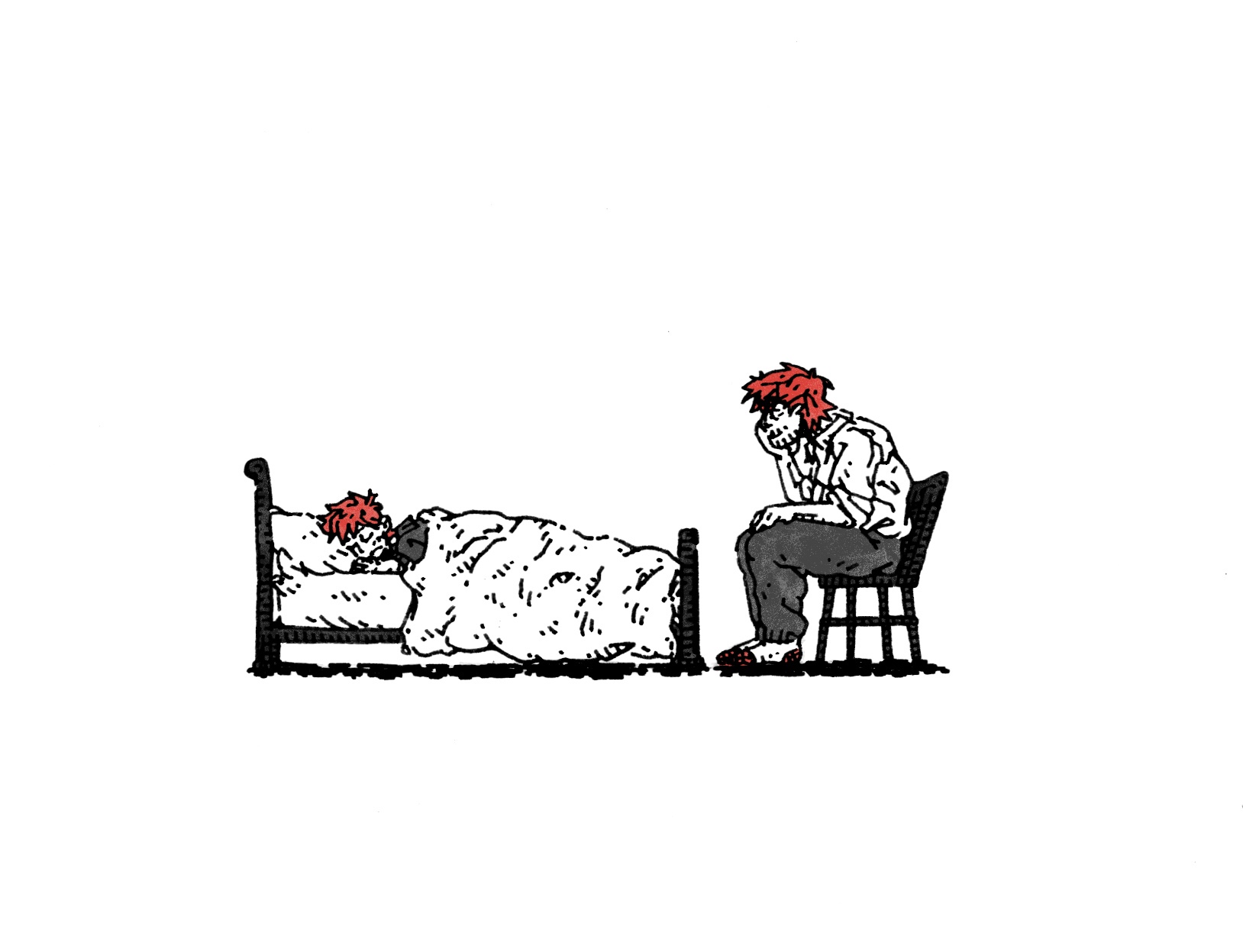
Field Notes from the Cafeteria
What're you sucking on there?
The other kids were already groping each other in the hallways by the time I started noticing girls. The boys were rolling their sleeves up above their shoulders to reveal tight little eggs of bicep. The girls were cutting low Vs into their school-issued gym shirts. Everyone was suddenly united in the effort to seduce each other.
I became aware that I wanted to be liked by girls at the same time I became aware that I was far, far behind the other boys in school. I already knew my body was different. I was the second-shortest boy in the grade. On the first day of middle school the assistant principal made us line up by height in the gymnasium so he could distribute school uniforms. Only Sandro B. was behind me. I was used to looking up at people when I talked to them, used to crawling into tight spaces to fetch hard-to-reach items. But I was surprised to find there were other things about being a boy I lacked—things it seemed like everybody already understood but me.
I discovered that most of the work of being a boy had to do with girls, and girls was a subject about which I knew very little. I couldn’t keep up when the boys wanted to talk about girls—which girls were hot and which were not; the parts that were growing on them and the parts of us that they liked, if we could grow them fast enough. I hadn’t gone on any dates, told a girl I liked her, or been told I was liked. I couldn’t tell you what made 69 any different from 70.
I had ground to make up. So, like any enterprising student, I went about finding tutors. There was a group of boys who liked to talk about these things at the lunch table. I think they liked to show off, and I gave them plenty of opportunities for it. They accepted me into their gang, and just like that I’d made the first male friend group of my life.
My real education happened in the lunchroom. I stayed quiet, taking my cues from the others. I laughed when they did, nodded when they used a term I hadn’t heard before: semi, blue balls, second base. My inability to provide commentary of my own left me vulnerable. If I continued to sit out they might peg me as an imposter. But I could mimic them well enough, and eventually I managed to earn small victories where I could. One day, when two of the boys were sucking lollipops at the lunch table, I was hit with a stroke of inspiration. “What’s that in your mouth, a penis?” I asked one, gesturing to the white stick dangling from his mouth. “Why don’t you make them sword fight?” It wasn’t perfect; proper form would have dictated I use a word like “dick” or “cock.” But it was a respectable effort, and it went over well enough. Everyone at the table laughed, and the leaders of our clan, Andres and Elijah, took to it at once, lunging at each other and clashing their lollipop sticks. I was on cloud nine.
These boys gave me my first lessons in the art of masculinity. Slowly, a sense of solidarity grew in me—that feeling that we were of a kind, and a resulting kinship that did not derive its strength from our words or actions or feelings but the simple fact of being together. This implicit allegiance still exists for me today; it’s perhaps the most enduring social expectation of my life.
Of course, there was much I couldn’t speak about to my gang. That I still called my parents “Mommy” and “Daddy,” for example. Or that I was so averse to blood that I kept a bottle of contact solution in the smallest pocket of my backpack so that I could make myself blind in the bathroom whenever the teacher “treated us” to an R-rated movie in class. Or that it made me sad when they made a short joke. Those things sat like fat stones in my chest. I thought there must be something terribly wrong with me, and I was ashamed. The parts I learned to be ashamed of were the parts I knew the boys at the lunch table would laugh about. Bit by bit, I worked to hack them away. And those I couldn’t, I hated. This was around the time I stopped crying.
Nothing gave me more anxiety than my after-school practical sessions, when I would test my skills against the very elite in pubescent masculinity. Every Tuesday and Thursday I took the bus to soccer practice, and for ninety minutes tried to blend in with the boys who were living evidence of how far I still had left to go. The soccer boys were a different breed. They were muscled and tall; they wore deodorant that smelled like cleaning fluid. They called each other “bro” and kissed girls and slept, I was sure, not in pajamas but in underwear only.
Soccer practices were nerve-wracking, but I can’t deny their efficacy. I became comfortable talking about porn, and uncomfortable sitting with my legs crossed too tightly. I became versed in the subtle body cues that initiate a touch by palm or knuckle or shoulder. I took my insights back to school, and soon enough I was holding my own with the boys at the lunch table. What began as an apprenticeship turned into a friendship, perhaps even a brotherhood, and I came to expect nothing more from them than fun, ease, a certain social cachet, and a common interest in unlocking the mysteries of women, together.
Around that age I remember adults telling me often to be myself. But it always seemed a hopeless exercise to me, a bit like advising Sisyphus to “put your back into it”—you don’t think I’ve tried that already? The truth was I had no self to be. Like most pubescent children, I wanted to be whatever it was other people wanted me to be. Since I was an American boy, I learned quickly that other people wanted me to be a man.
And so began my indoctrination into the cult of masculinity. At first I knew I was pretending. But eventually I forgot.