A Few Square Blocks
Sometimes you have to leave home to find your way back.
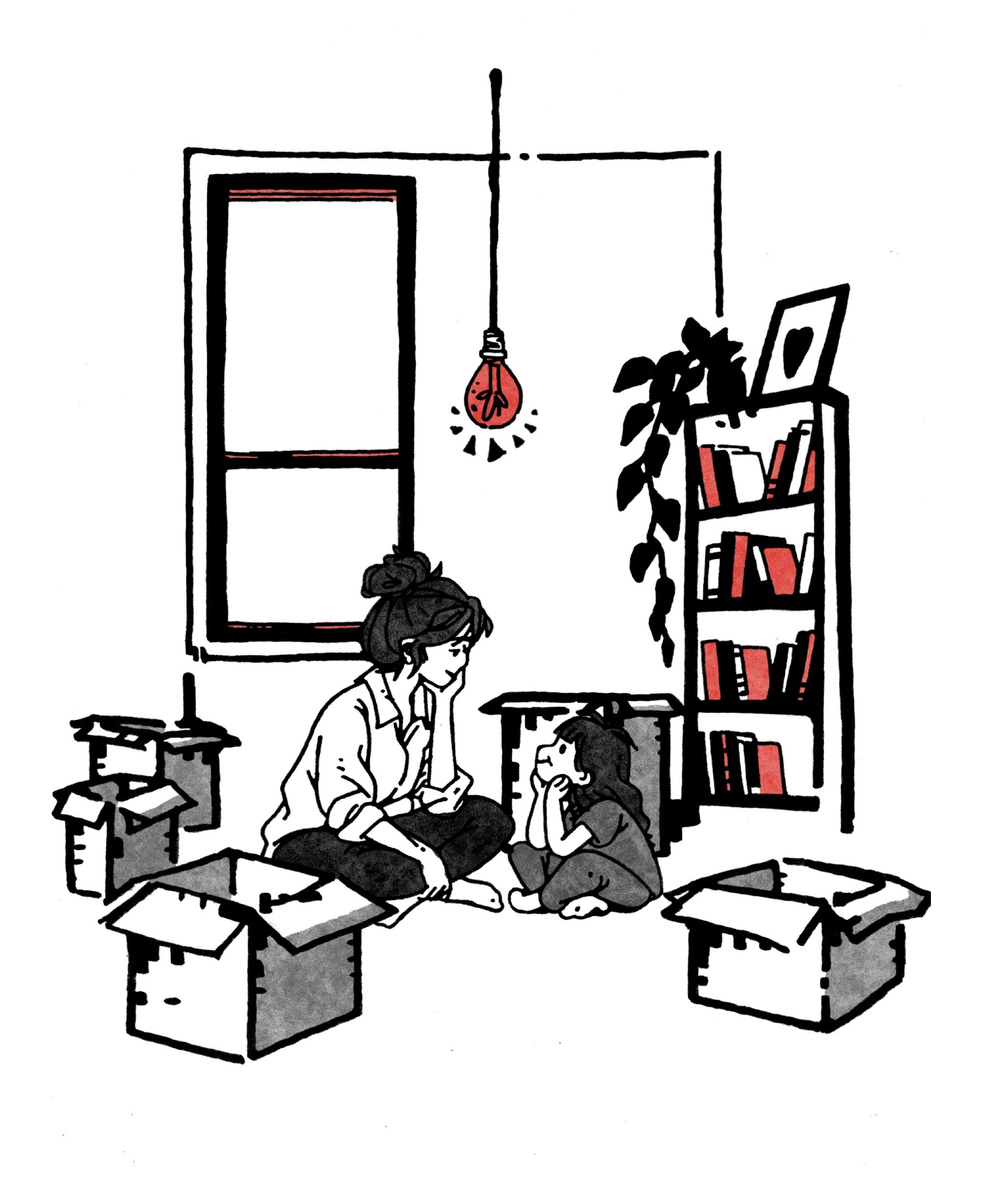
When my daughter was 3, we moved into an apartment in Carroll Gardens. It was, in every way, the opposite of the home we had left, a drafty three-story brick house in Ditmas Park with antique doorknobs that kept falling off. Our new place was bright and modern, but also—as I realized with a sense of dread on move-in day—empty. No musty couch to sink into, no toys to trip over, no mail strewn over the hall table to remind me that I had a life.
The first night we slept there, we ate Szechuan green beans with our fingers because we didn’t have any forks, which thrilled my daughter but left me with a pit in my stomach. The light bathing the apartment in the mornings through huge curtainless windows seemed accusatory: you left your marriage, you took your daughter away from a life she loved, there will be no hiding your shame.
That first weekend, we ventured out as far as the playground. “What do we do now?” my daughter asked me after an hour of climbing and swinging while the F train roared overhead. It was noon on a Saturday, and we had nowhere to be, no one expecting us.
I had been the one to leave because, by the end, my husband felt like a stranger. Like that house in Ditmas, our marriage felt heavy, lightless, silent. Still, as I looked at my daughter, her question hanging in the air, I felt like a failure.
It’s no wonder that I nearly ran over a man sweeping the sidewalk on Court Street. “Whoa,” he said, smiling and kneeling down beside my daughter in her stroller. “I think your mommy wants me to fall in there with you.” My daughter giggled.
Doug was the owner of Buttermilk Channel, a restaurant that had just opened up across the street. He looked at me with a sympathetic gaze. “How about you guys come on in for lunch?” he said, ushering us toward the door. The restaurant was empty. “As you can see, we can use the company.” After our meal, the waitress served my daughter an ice cream in the shape of a clown. For the first time in weeks, I found myself smiling.
The end of any marriage, even an unhappy one, is a jarring plot twist in the story you’ve constructed for yourself. “You think you bought a ticket to a rom-com, and all of a sudden you’re watching a horror movie,” I joked to my friends, pretending to be lighthearted.
But the truth was that in the months after our move, as we bought forks, screwed together Ikea bookcases, and taped drawings to the fridge, the divorce I had fought tooth and nail for left me intensely lonely. The worst part was that I had sworn to do it better than my parents’ marriage, which had been seething with tension. “Why didn’t you call me?” my brother asked me later when I told him how sad I’d been. How could I tell him that I was too ashamed; that I was mourning the loss of the story I had told myself all those years of our childhood—that I would not live in a home starved of love; that my daughter would grow up with parents who understood and respected each other? I’d failed to do all of it.
And yet, something else was happening too. Almost imperceptibly, thin tendrils of connection were forming around me. That initial invitation to enter Buttermilk Channel grew into regular visits, my daughter bouncing happily on a bar stool sipping Shirley Temples while I chatted with the bartender. The local dry cleaner, always perched on her stool by the window, would greet me with a wave and a hello every morning, ushering us in for pretzels from her big jar. No tear in the fabric of any stuffed animal was beyond her ministering art. And then there was the meatball sandwich with pickles at Court Street Grocers—it never failed to pick me up.
I don’t remember exactly when, but at some point I noticed that neither of us was asking “What do we do now?” anymore.
When people visit a shiva, they are instructed not to ask mourners “How are you?” or “What can I do?” They are not there to talk the mourner out of their grief; they are there to remind them, with their very presence, that normalcy will return, that life will go on, that what they have suffered is a twist, yes, but not the end of the story. That’s what the neighborhood was doing for me, long before I had words for it.
Over the years, the neighborhood has helped me write new chapters with my daughter, too. We love going to Books Are Magic and sitting for hours, paperbacks propped on our laps. For us, the cavatelli at Frankies has always been more than just a delicious meal. Ordering that buttery, spicy pasta has become a bonding ritual. No matter how mad she is at me, no matter what distance has opened between us, something about that warm and welcoming place softens us to each other. Even our building, once so forbidding with its sterility, has opened itself to us. My daughter called our doorman on the house phone every night until he retired. “Good night, Roscoe,” she said. “Don’t let the bedbugs bite, little girl,” he responded.
Fifteen years after moving in, I have friends down the hall, a book club in my building, a neighborhood group of women who get together every Monday for a game of mahjong, and, best of all, a group of single moms I celebrate holidays with. My first daughter, and a second one who came a decade later, have developed their microcommunities here, too. But rich as those things are, it’s not the intentional community I’ve created that makes me feel less alone when bad things happen. It’s the accidental community, the people around me from whom I ask nothing and who ask nothing of me besides a little everyday kindness.
I will never have anonymity in these few square blocks inside Carroll Gardens. What I have instead is something I couldn’t have planned and wouldn’t have believed possible: a place—a life—where I feel known.